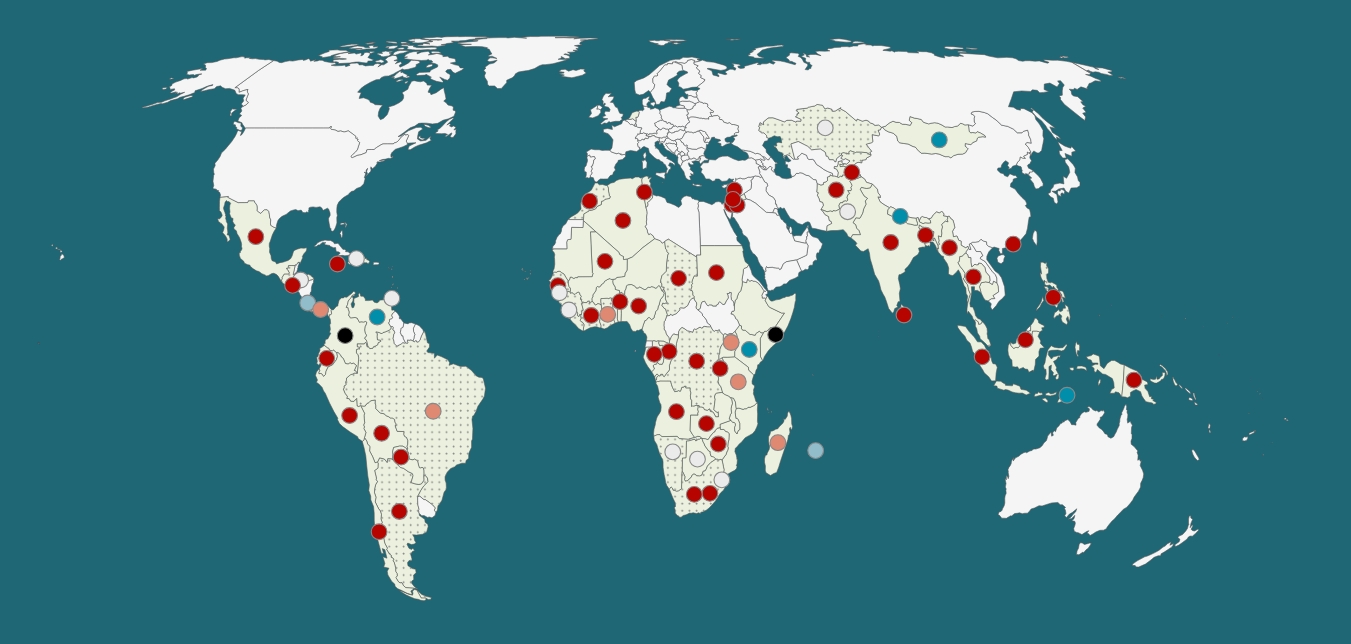
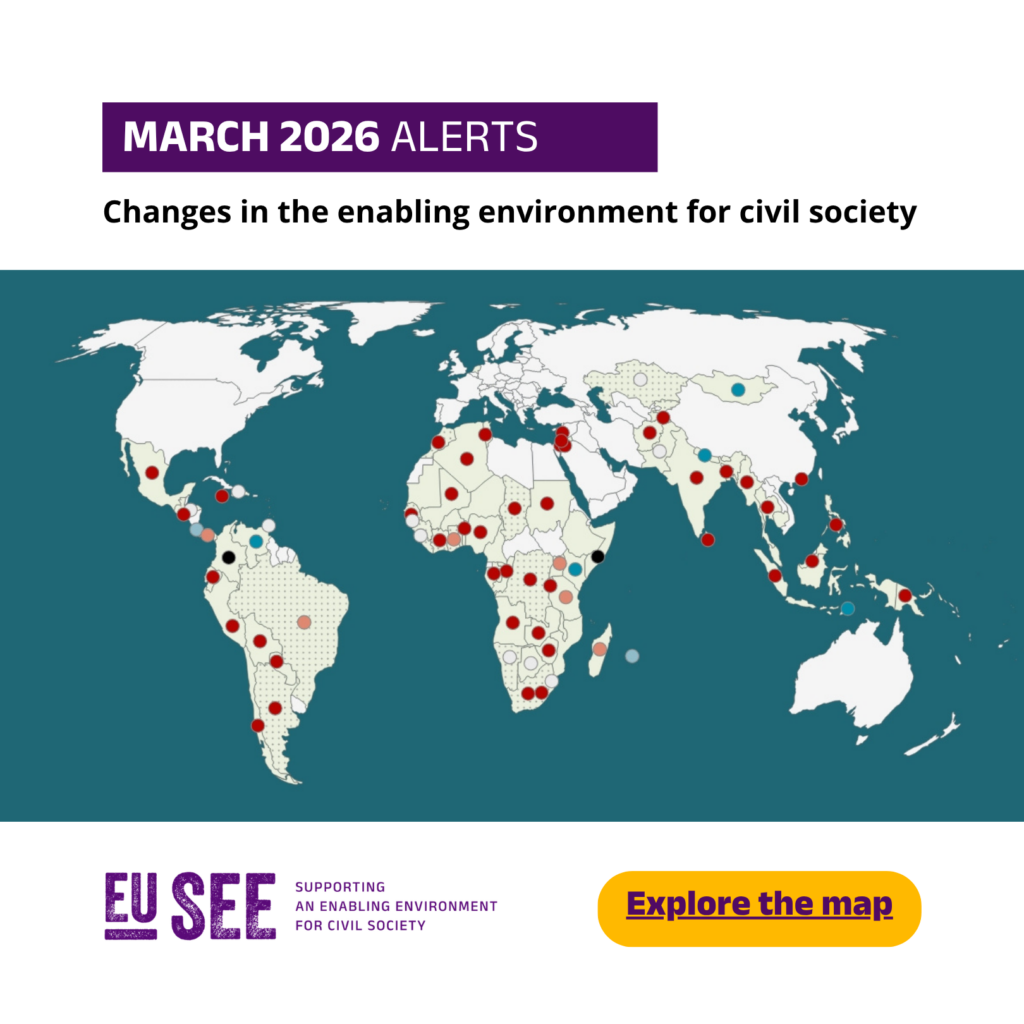
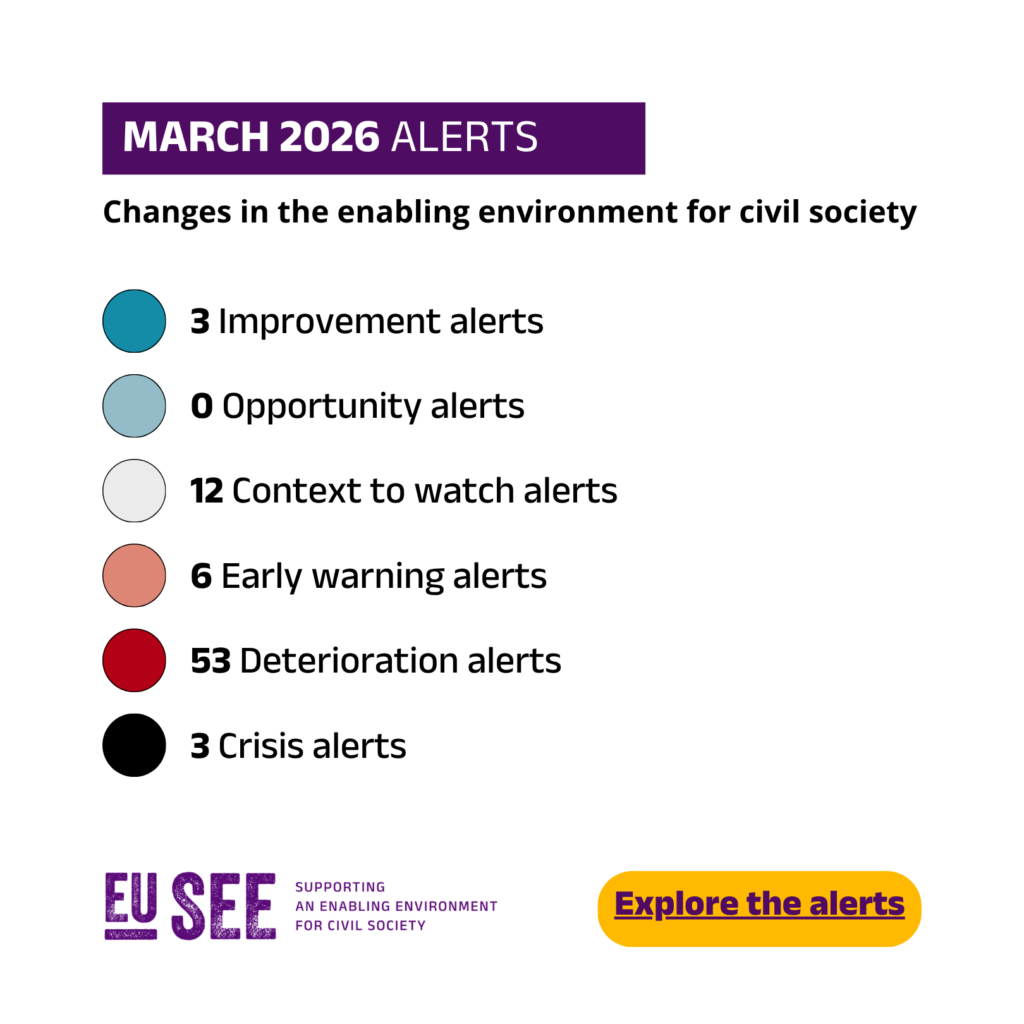
March 2026 was characterised by a further consolidation of security‑driven governance and institutional control over the enabling environment for civil society globally, accompanied by escalating pressure on civil society, media, and political opposition across regions. The use of a variety of repressive laws, particularly terrorism and financing laws, as well as criminalising rhetoric, against journalists and activists is on the rise. While isolated institutional advances, such as Nepal’s peaceful elections, judicial protections for journalists in Panama and Sierra Leone, and accountability rulings in Ecuador demonstrated the continued relevance of civic and legal pressure, EU SEE continues to observe the widespread expanding of surveillance powers, shrinking civic freedoms, and the use of constitutional, security, and criminal law tools to deter dissent.
March was a busy month for EU SEE reports, with 23 in-depth Enabling Environment Snapshots and Country Focus Reports published; the full list is published at the end of this text.
Emerging Trends
Expansion of Security, Surveillance, and Prosecutorial Power
March saw an increase in the deployment of national security, cybercrime, and prosecutorial frameworks that concentrate discretionary power while eroding safeguards, with the intention to deter and silence civil society actors.
In Israel, the establishment of a new police “incitement unit” raised concern about proactive monitoring of social media users and the politicisation of speech‑related investigations under the influence of the National Security Minister. Critics warned that the unit could be deployed against protest activists, government critics, and Arab citizens well beyond genuine incitement to violence.
In Hong Kong, sweeping amendments to the National Security Law’s Article 43 implementation rules dramatically expanded police powers to compel decryption, seize property, weaken legal professional privilege, and impose criminal liability on those associated with suspects, including family members, deepening a coercive ecosystem of surveillance and intimidation.
In Malaysia, concerns over institutional accountability were raised by the fast‑tracked Constitution (Amendment) (No. 2) Bill 2026 on separating the roles of Attorney‑General and Public Prosecutor. Despite being framed as a reform, civil society and political actors flagged the retention of executive influence over prosecutorial appointments, the transfer of absolute discretion without meaningful judicial oversight, and conflicts of interest embedded in governance structures.
Concurrently, Zambia, Jordan, and Pakistan continued their criminalisation of online speech and association via cybercrime and national security laws, targeting opposition leaders and activists in ways that expand liability to digital platforms, specifically targeting critical commentary, and indirect association.
Sustained Assault on Media, Culture, and Academic Space
Journalists, publishers, students, and cultural spaces remained under structural pressure throughout March.
In Benin, a journalist was sentenced to five years in prison by the CRIET (Court for the Repression of Economic Offenses and Terrorism) for the alleged glorification of a coup attempt, reinforcing a pattern of criminalising journalistic conduct before anti‑terrorism courts. In Burundi and Papua New Guinea, journalists faced arrest, assault, and detention for routine reporting on governance and human rights abuses, reinforcing a climate of fear and self‑censorship.
Conversely, accountability mechanisms in Sierra Leone and Panama provided rare positive signals by reaffirming protections against unlawful dismissal and prior censorship, illustrating the critical role of independent, well functioning oversight institutions to balance the enabling environment.
Criminalisation and Delegitimisation of Civil Society
March also reflected heightened efforts to discredit, intimidate, or neutralise civil society organisations through administrative, rhetorical, and also coercive means.
In Jamaica, the Deputy Prime Minister and Minister of National Security publicly accused Jamaicans for Justice (JFJ) of “living off blood money” at the tail end of February, in response to their criticism of police shootings and accountability failures. Such rhetoric contributes directly to the stigmatisation of watchdog organisations and fuels hostile narratives that endanger civil society actors operating on sensitive human rights issues.
Similarly, in Tanzania, official calls for the scrutiny of NGOs in Ngorongoro framed advocacy work as “propaganda,” reinforcing delegitimising discourse that risks chilling community engagement and rights‑based organising.
Conflict, Militarisation, and Civic Space Collapse
Escalating insecurity and conflict continued to hollow out civic space in several regions.
In Somalia, disputed constitutional amendments, delayed elections, and tensions between federal authorities and member states progressed into armed confrontation in Baydhabo, disrupting humanitarian access, governance, and civil society operations.
In Sudan, drone attacks on humanitarian facilities and the detention of women activists continued to devastate the enabling environment for civil society, while Sudanese organisations amplified calls for accountability at the UN Human Rights Council.
In Mexico, the killing of cartel leader “El Mencho” triggered coordinated violent retaliation, severely restricting freedom of movement and reinforcing climates of fear, self‑censorship, and a lack of state control in the affected region.
Electoral Processes Under Mixed Conditions
March revealed contrasting trajectories in electoral governance.
Nepal’s peaceful parliamentary elections marked the significant recovery of constitutional order and public trust following months of uncertainty in the wake of Nepal’s political revolution last year.
Paraguay’s deployment of electronic voting machines amid weak auditability and limited dialogue raised concerns about electoral integrity.
In the Republic of the Congo, a nationwide internet shutdown during presidential voting starkly illustrated the use of digital repression to constrain transparency and citizen monitoring. This trend reflects the growing use of internet shut downs and other ’emergency tools’ during periods of political transition.
Civil Society Resilience Amid Repression
Despite intensifying constraints, civil society actors continued to demonstrate resilience.
In Tunisia, the release of lawyer Ahmed Souab reaffirmed the impact of sustained national and international pressure, even as uncertainty persists for others still detained. In Guinea‑Bissau, organisations continued public education, advocacy, and community mobilisation despite raids, intimidation, and political uncertainty.
March Country Focus Reports and Snapshots
- Bangladesh Country Focus Report
- Trinidad and Tobago Country Focus Report
- Mali Country Focus Report
- Colombia Informe Enfoque País
- Nepal Country Focus Report
- Panamá Informe Enfoque País
- Sri Lanka Country Focus Report
- Jordan Country Focus Report
- Sudan Country Focus Report
- India Country Focus Report
- Papua New Guinea Country Focus Report
- Paraguay Enabling Environment Snapshot (Spanish)
- Senegal Enabling Environment Baseline Snapshot (French)
- Republic of Congo Baseline Snapshot (French)
- Guinea Enabling Environment Baseline Snapshot (French)
- Peru Enabling Environment Snapshot
- Kyrgyzstan Enabling Environment Baseline Snapshot
- Tanzania Enabling Environment Snapshot
- Colombia Enabling Environment Snapshot (Spanish)
- Sierra Leone Enabling Environment Snapshot
- Costa Rica Enabling Environment Snapshot
- Sri Lanka Enabling Environment Snapshot
- Bangladesh Enabling Environment Snapshot