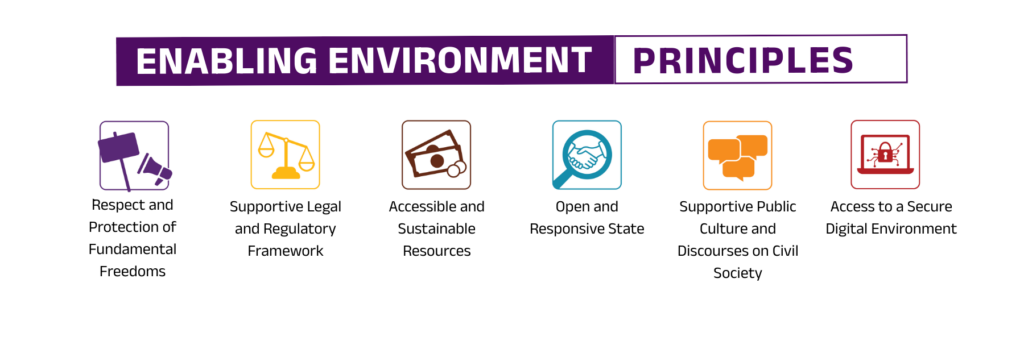

An enabling environment is one where civil society can thrive, express itself freely, and actively engage in shaping its context. Freedom of expression is indispensable in an enabling environment; citizens must feel secure in expressing opinions and sharing information online and offline. Similarly, the freedoms of association and peaceful assembly allow individuals to pursue collective goals unhindered. When these rights are respected and protected we have an open civic space and citizens have space to organise, participate, and communicate effectively.
While “civic space” and “enabling environment” are often used interchangeably, the “enabling environment” is a broader concept more action-oriented and outcome-driven. It describes an environment that not only respects and protects fundamental freedoms but also facilitates the effective work of civil society. The autonomy and operational freedom of civil society must be ensured. This assurance needs:
- The respect and protection of fundamental freedoms.
- A legal and regulatory framework that facilitates establishment, protects against unwarranted interference, and provides a solid legal basis for civil society activities.
- Access to sustainable resources to enable civil society to carry out its mission effectively.
- A constructive engagement between the state and civil society where both types of actors (public bodies and civil society actors) converge in the formulation, implementation and evaluation of public policies.
- Transparency, accountability and meaningful, inclusive collaboration in policy-making and governance processes.
- Access to digital technologies to facilitate free and secure operations in the digital realm, without the threat of censorship, online manipulation, disinformation, or disruption of digital rights.