
Over the past year, Lesotho’s enabling environment for civil society has faced significant challenges and developments affecting civic space, legal frameworks, and state-civil society relations. Key events include incidents of the police and military using excessive force against protesters, legislative debates on digital rights and freedom of expression, and increasing constraints on public participation.
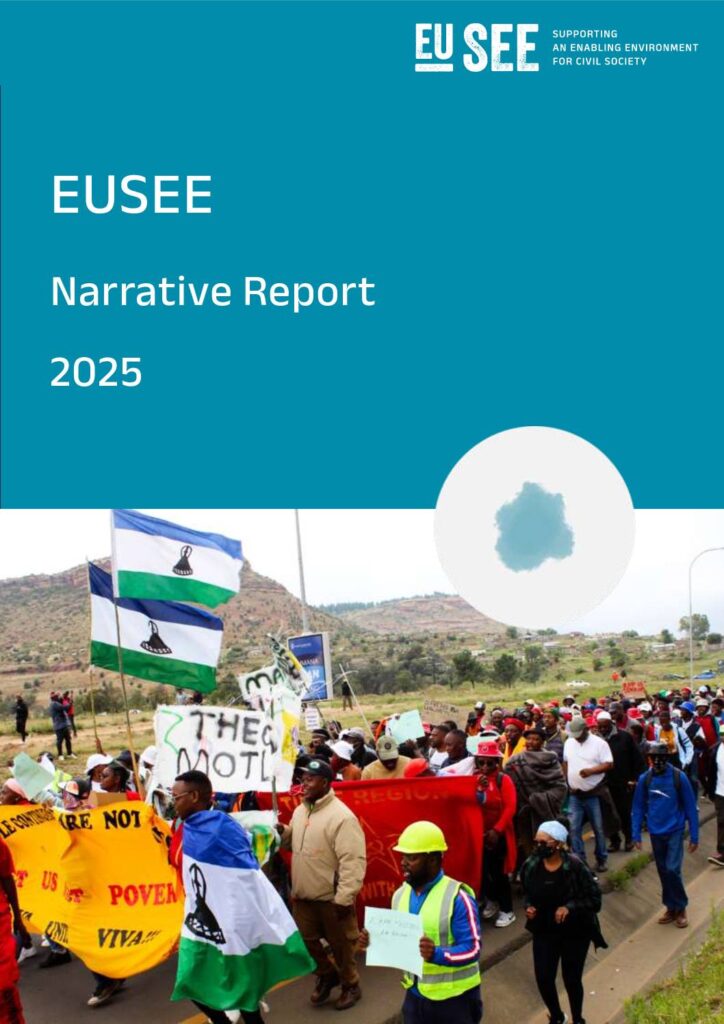
In February 2025, police whipped and arrested some members of the Mokhotlong taxi operators, contractors, and villagers protesting against government policies related to the awarding of jobs in the Lesotho Highlands Water Project dam construction to contractors from outside the district, highlighting concerns over excessive use of force and restrictions on public assembly. Similarly, during the launch of the Polihali Dam under the Lesotho Highlands Water Project Phase II, soldiers violently removed protesting community members, sparking widespread condemnation. Human rights defenders have also faced intimidation, with reports of threats from military officials, further restricting civic engagement.
The ongoing consideration of the 2024 Computer Crime and Cybersecurity Bill in the National Assembly poses another major challenge, as its provisions could criminalise online dissent, restrict access to information, and stifle transparency. Additionally, restrictions on protest permissions under the Public Meetings and Procession Act 2010 have undermined freedom of peaceful assembly, as seen in the cancellation of a planned student demonstration due to the imposition of overly restrictive requirements by the police in February 2025. For the planned student demonstration, the police restricted procession time to two hours and forced students to follow a punishing uphill route to the National Assembly in Maseru.
Public participation in governance remains superficial, with civil society organisations (CSOs) given a limited time to contribute to legislative reforms through comments or the submission of alternative drafts. Reports suggest that government consultations with CSOs are often tokenistic, with their recommendations frequently disregarded in policy-making processes. Furthermore, while international donor funding remains available, it is limited, and CSOs continue to struggle with financial sustainability due to the absence of government support.
The digital space in Lesotho remains relatively open, but journalists and civil society actors face covert surveillance and harassment in the form of threatening messages received via social media platforms. A positive development, however, was the Constitutional Court ruling in November 2023 that struck down a controversial provision of the National Security Service Act of 1998, which had allowed authorities to seize private communication data without adequate legal oversight.
Enabling principles scores