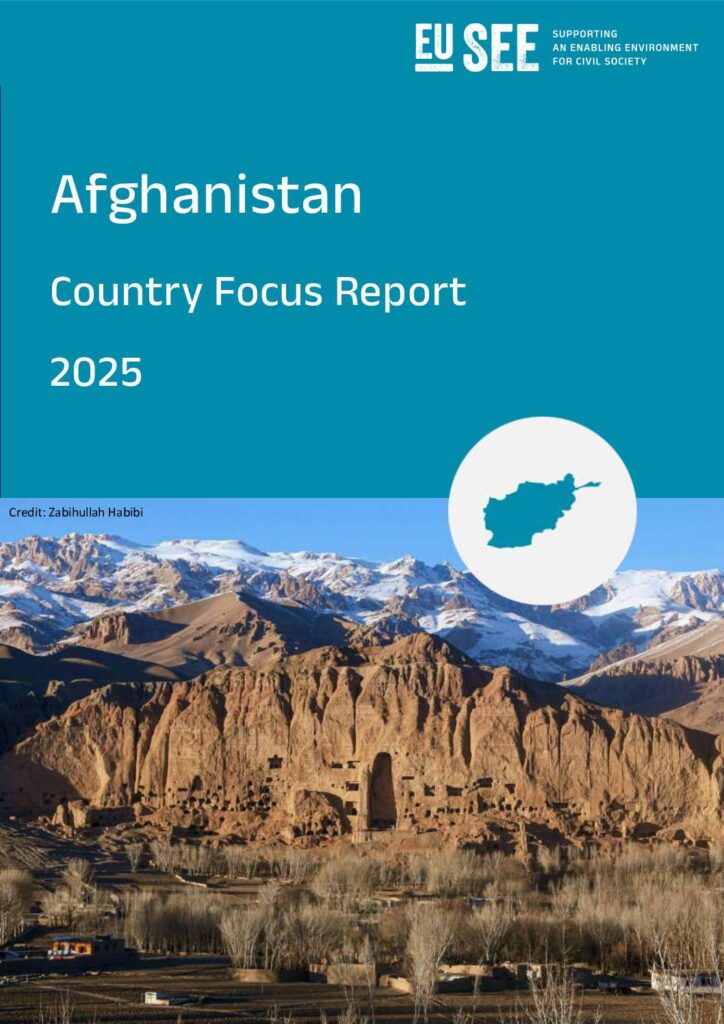
Since the Taliban’s armed seizure of power in August 2021, the de facto authorities (DFA) have increasingly used authoritarian methods to maintain control of Afghanistan. Political parties and discussions are banned, the media is heavily controlled, civic space is closed, and the Taliban uses ruthless methods to stamp out any remaining pockets of free thought or opposition. Trends over the last twelve months include increased digital surveillance, additional controls on the media including the banning of audio-visual broadcasts, and the stricter enforcement of the Propagation of Virtue and Prevention of Vice Law (PVPV) that was passed in 2024.
Freedom of expression, assembly and association are now completely forbidden by Taliban policy, and human rights defenders (HRDs), women human rights defenders (WHRDs) and journalists are routinely harassed, unlawfully arrested and detained, and even tortured and killed. Since the takeover, the Taliban has forcefully built and implemented a system of gender apartheid that has severely restricted the rights of women, girls, and LGBTIQ+ persons, to the point of near total erasure from society.
Women and girls are subject to multiple layers of restrictions. The Taliban has banned them from schools above grade six, from universities and all forms of training, including medical training. The vast majority of women are not allowed to work. Even where there are exceptions – for example in healthcare – the DFA impose so many requirements on dress, movement and chaperoning that even women in exempted professions often find it impossible to continue their work. Women, particularly those from ethnic minorities, are frequently harassed, beaten, detained and subjected to sexual or gender-based violence (SGBV) in detention for wearing the ‘wrong’ kind of hijab or doing food shopping without a chaperone.
The situation has led CSAs and CSOs (broadly defined to include all those listed above) to self-censor, forcing many to operate from exile, work in secrecy, or halt their activities altogether. Although the de facto authorities have undermined all CSAs’ work, the impact on WHRDs has been more severe as they are targeted both for their work and their gender. The December 2022 ban on women working for NGOs is a clear example of this.
The Taliban have also dismantled the legal framework that once protected and supported the work of CSAs. Soon after seizing power, the DFA effectively suspended the constitution and legal system that was in place prior to August 2021. They rule by decree, the most expansive of which to date is the 2024 PVPV law, which establishes the Taliban’s version of Sharia law (Islamic Law). The funding cuts from European and US governments have further eroded the enabling environment for civil society. What little funding is available is hindered by the Taliban’s actions, which include the demanding of bribes from humanitarian workers to allow them to do their jobs. Political culture and public discourse on civil society are generally negative, often portraying international NGOs as spies for Western governments and CSAs as anti-Taliban. Additionally, both CSAs and citizens are surveilled digitally and physically, and misinformation is widespread.
One of the numerous crises buffeting Afghanistan during 2025 was the mass forced return of a staggering number of Afghans from Iran and Pakistan. Between January and December 2025, UNHCR documented the return of 2,869,900 people, of whom 1,401,800 (or 49%) were deported. While the remainder are classified as ‘voluntary’ returns, the vast majority of those individuals and families felt forced to return because of the hostile environments created by the Iranian and Pakistani governments. It’s a reflection of the tumultuous year that was 2025 that this vast population movement and resulting humanitarian needs received hardly any attention on the international stage.
Many members of Afghan civil society who had taken refuge in Pakistan and Iran after the Taliban takeover in 2021 were caught up in the arrests and deportations. In November and December 2025 alone, 12 Afghan media workers (including one woman) and two of their children were detained by Pakistani authorities[1]. Some have likely already been forcibly returned to Afghanistan, while others remain at imminent risk of deportation. Journalists and civil society activists are at particular risk of reprisal attacks by the de facto authorities on their return to Afghanistan. For example, an HRD who was deported from Iran on 20 August 2025 was arrested just four days after he arrived in Afghanistan; he was reportedly beaten during his arrest and subjected to torture while in detention.
[1] Case details documented by an Afghan human rights organisation.
Enabling principles scores