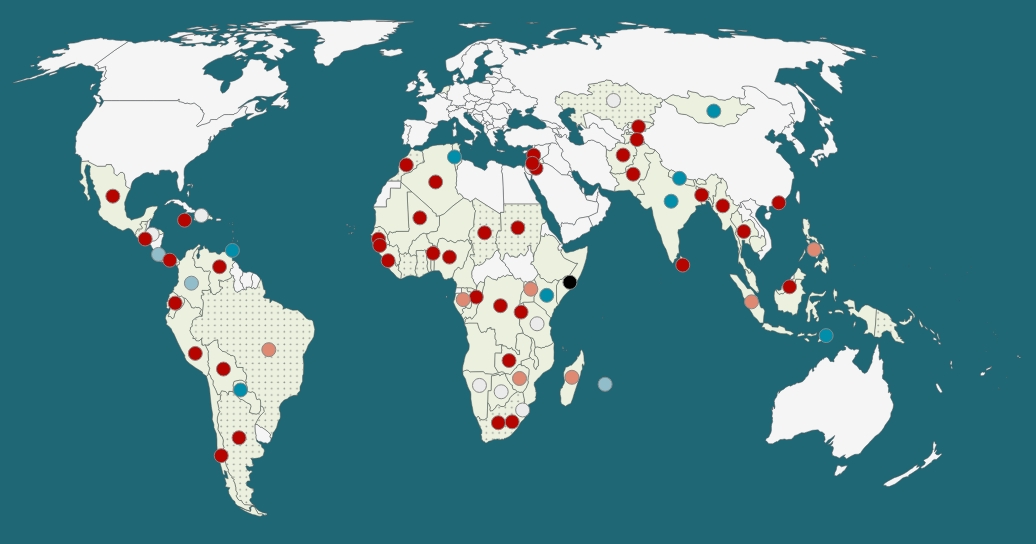
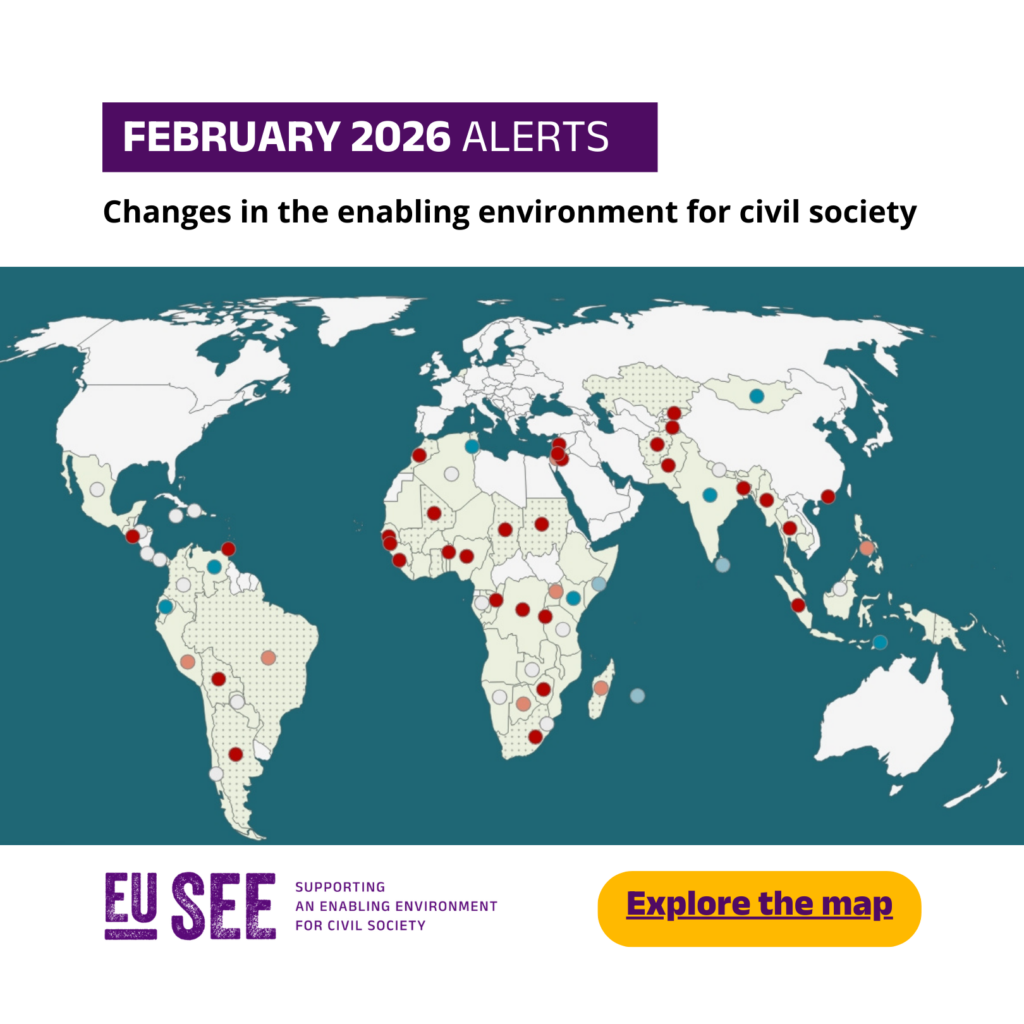
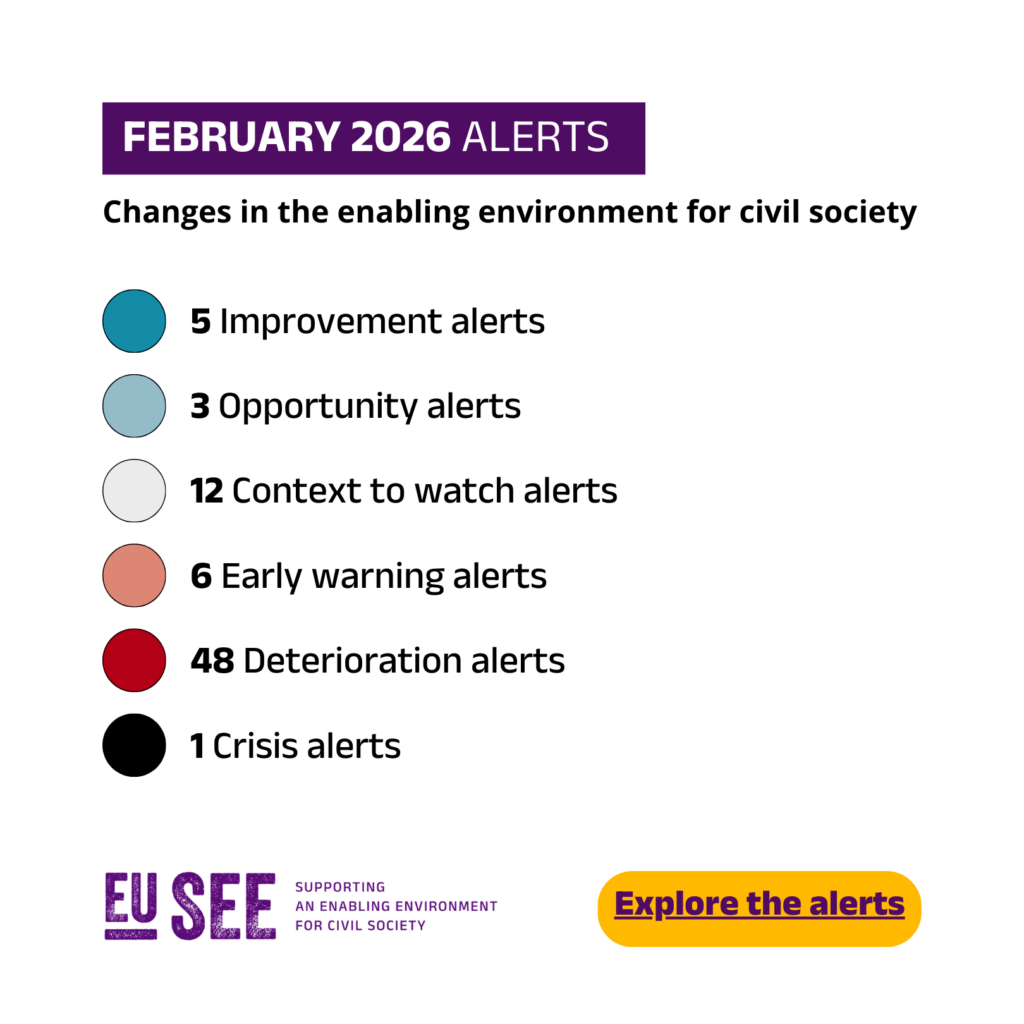
February was marked by intensifying constraints on the enabling environment for civil society space across multiple regions, even as some positive steps underlined the continued importance of civil society advocacy, such as Nepal’s withdrawal of its restrictive Social Media Bill, and the reactivation of dialogue on regulations to protect the right to protest in Colombia. The month underscored an increasingly precarious enabling environment, where civic actors face escalating legal, political, and physical risks. This is reflected by the significant quantity of deterioration alerts (48 out 77 total alerts).
Emerging Trends
1. Intensified Repression of Civic and Community Institutions
In occupied East Jerusalem, Israeli authorities closed the Burj al‑Luqluq Community Association for six months. The closure decision will affect 300–500 direct beneficiaries who rely on the association. Similarly, in Sudan, RSF‑aligned forces detained former journalist Manal Mustafa, whose home-based women’s empowerment pastry-making centre was targeted following a training she hosted. Four CSOs in Sudan also saw their registrations cancelled.
In Algeria, February saw continued prosecution of academics, including the cases of lecturer Tahar Ouhachi, and economist Djelloul Slama, reflecting a deepening pattern of harassment of free expressing voices in cultural spaces.
Direct action by authorities against cultural and community organisations is a growing trend that we observe across our alerts and reports.
2. Digital and Media Freedom Under Renewed Pressure
Staying with Algeria, journalists Mustapha Bendjama and Abdelali Mezghiche continue to be prosecuted. The Gabon media regulator suspended all social media nationwide, indefinitely, citing moral and security grounds, while in Zimbabwe, Government officials issued warnings against online ‘defamation’ of politicians, amid attempts to extend the Presidential term and amend the constitution. In Ecuador, press accreditation rules tied to editorial line further limited media access to military‑related briefings, and in Bangladesh, the army temporarily detained 21 media workers following publication of a protest‑related video.
Governments continue to intensify restrictions on online expression, press access, and digital communication, as a means to choke dissent and restrict the enabling environment for civil society.
3. Civil Society Operates within a Ever-harsher Political Environment
Israel revoked the licenses of 37 international humanitarian organisations in Gaza in January 2026, escalating an already severe and desperate context.
In Somalia, armed clashes in Baydhabo significantly restricted civil society movement, program delivery, communication, and coordination. In Panama, asset freezes against environmental NGOs CIAM and Adopta Bosques Panamá created severe operational risks and instilled a chilling effect on watchdog activities.
The use of strict legal and creative administrative mechanisms to curtail the work of civil society is a developing trend, with certain governments choosing administrative forms of oppression that are often more covert and draw less attention, as a favoured means of restricting civil society.
4. Legal and Constitutional Engineering as a Tool of Control
The use of legislation and administrative reform to reshape political order accelerated across several regions.
As noted, In Zimbabwe, a constitutional amendment to extend presidential terms was controversially approved by the Cabinet. But constitutional changes continue apace elsewhere, having varied impacts on the enabling environment. In Kazakhstan, a new constitutional draft raised concerns among civil society over attempts to limit freedom of speech based upon ‘public morality’ and to impose transparency rules targeting any foreign funding of NGOs.
Myanmar’s junta established an extra‑constitutional Union Consultative Council with sweeping powers across all branches of government, further consolidating their authoritarian grip on power.
in our article on constitutional change in Africa, we bring together the views and advocacy tips of our network members, proving a key resource for civil society organisations looking to engage governments on constitutional change.
5. Selective Openings and Civic Advocacy Gains
Nepal’s withdrawal of the restrictive Social Media Bill reversed a major threat to digital rights ahead of the 5 March election. Our podcast digs deeper into the current situation in Nepal; a country in a state of flux following a Gen-Z led political uprising at the end of 2025. In Botswana, sustained advocacy by BOCONGO led to expanded consultations on constitutional reform, although concerns over timing and inclusivity remain.
In Algeria, the release of activist Lyes Touati following international pressure signaled the value of coordinated advocacy from national and international changemakers.
Trinidad and Tobago’s accession to the Escazú Agreement represented a concrete step toward strengthened environmental rights, while consultations on Costa Rica’s FATF‑aligned reforms have begun. The initiative seeks to achieve a risk-based proportionate and non-discriminatory framework, and avoid excessive administrative burden.
February Country Focus Reports and Snapshots
- Colombia Country Focus Report (Spanish available)
- Afghanistan Country Focus Report
- Madagascar Country Focus Report (French available)
- Tunisia Country Focus Report (French available)
- Malaysia Country Focus Report
- Benin Country Focus Report (French available)
- Lesotho Country Focus Report
- Zimbabwe Country Focus Report
- Tanzania Country Focus Report
- Mauritius Country Focus Report
- Gabon Focus Country Report (French available)
- Botswana EE Snapshot
- Nepal EE Snapshot
- Palestine EE Baseline Snapshot
- Cote d’Ivoire EE Baseline Snapshot (French available)
- Cambodia EE Snapshot
- Nigeria EE Snapshot
- Mongolia EE Snapshot