By Clarisse Sih and Bibbi Abruzzini, Forus, EU SEE consortium partners
In many parts of the world, the enabling environment for civil society has long been shaped not only by overt bans, arrests, or the closure of organisations, but also by more subtle forms of restriction. Among these is content suppression — a quieter and often less visible tactic used by governments and other powerful actors to limit civic space and control narratives.
Rather than outrightly prohibiting civic action, authorities are increasingly controlling what can be seen, shared, archived or amplified — both online and offline. Plays are cancelled, archives erased, social media accounts taken down, symbols banned and entire concepts removed from public discourse. The result is similar: fewer spaces for dissent, fewer narratives that challenge power, and fewer records of alternative voices.
Across regions, civil society actors warn that content suppression has become a central mechanism for restricting the enabling environment — often under the guise of legality, citing concerns such as copyright, public order, trademark protection or national values. The following examples illustrate how these practices operate across diverse political and cultural contexts.
Nigeria: visibility under pressure
In Nigeria, civil society organisations and independent media increasingly face algorithmic suppression, selective takedowns and content throttling, particularly when addressing governance issues, elections, corruption or security-sector abuses. While platforms remain accessible, critical voices report declining reach, unexplained removals and heightened risks when content challenges dominant political narratives.
“Algorithmic suppression is the new form of attack on civic space that civic actors now need to deal with in their work. While platforms allow for decentralised thinking or distributed thoughts, selective takedown and content throttling muffles the very idea of expression, ultimately weakening participation and inclusion. Disagreement (lack of consensus) is permissible in a democracy and is the only way society can remain civil. Unexplained removals take away the essence of civil society’s civility,” explains Oyebisi Oluseyi from the Nigerian Network of NGOs.
As documented by the EU SEE, this form of suppression does not always leave a clear legal trail. Instead, it creates uncertainty — discouraging organisations from publishing sensitive material and weakening public access to independent information. The opacity of platform governance mechanisms makes it difficult to contest decisions or seek remedy.
Hong Kong: cultural erasure and archive deletion
In Hong Kong, content suppression has extended beyond digital platforms into cultural institutions and academic archives.
In October 2025, the West Kowloon Cultural District Authority abruptly cancelled performances of “We are Gay”, an award-winning play by playwright Candace Chong, just hours before ticket sales were to open. Officials cited public complaints and confirmed the decision followed consultations with government authorities. Artists described the cancellation as part of a broader pattern of cultural blacklisting since the introduction of the National Security Law.
Weeks later, Hong Kong’s public broadcaster RTHK ordered university libraries to remove all archived RTHK content — including historically significant programs documenting social and political life over decades. Entire digital collections disappeared, while independent citizen archives on platforms like YouTube were also taken down.
“The Hong Kong Centre for Human Rights has been monitoring the development. They criticized this as an ongoing state-sponsored campaign aimed at combating ‘soft resistance,’ a deliberately vague concept used to justify suppressing dissenting voices and narratives that are not aligned with the Government’s perspective. The Centre is calling for action to support initiatives that protect and preserve the history of Hong Kong civil society, and to ensure opportunities for free artistic and cultural expression.” – Anonymous, Hong Kong Center for Human Rights
Together, these actions suggest a strategy that reaches beyond limiting present-day expression. They also affect historical memory. When archives disappear, societies lose not only critical voices but also the record of how debates unfolded, how movements evolved, and how institutions responded.
Philippines: platform systems as instruments of silence
In the Philippines, content suppression has taken a coordinated digital form. In December 2025, five prominent Facebook accounts belonging to media organisations, fact-checkers and commentators — including Nobel Peace Prize laureate Maria Ressa’s Rappler — were taken down simultaneously following identical trademark complaints filed by a single source.
Although the accounts were later restored, the incident exposed how platform systems and automated moderation tools can be exploited to silence critical journalism, even temporarily, at moments of political sensitivity.
“The incident demonstrated how the shift of social media platforms like Facebook towards artificial intelligence (A.I.) powered content moderation may be abused by certain forces to suppress free speech. A human moderator would have been able to thwart clear attempts of censorship. Netizens must demand social media companies and governments to protect fundamental freedoms against repressive forces online.” – EU SEE network member in the Philippines.
Such attacks create chilling effects far beyond the affected pages, signaling to other actors that visibility itself can be revoked without warning. Even short interruptions can disrupt investigative reporting, limit access to fact-checking, and undermine public trust in independent journalism.
Indonesia: criminalising symbols and shared identity
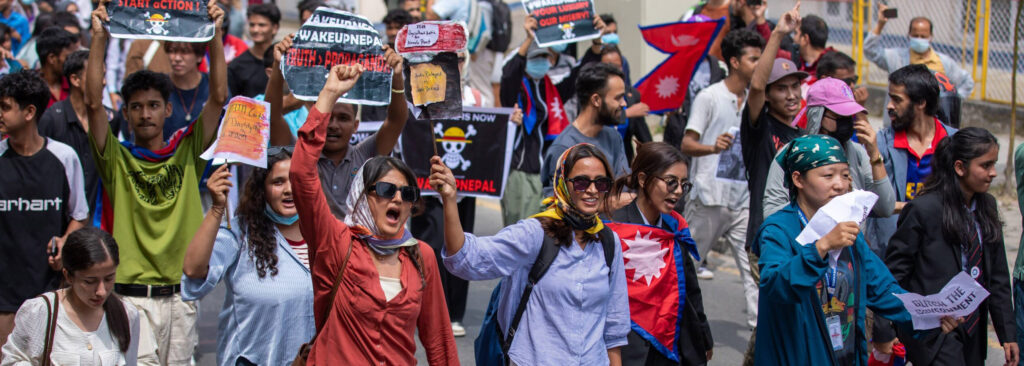
In Indonesia, content suppression has extended into the realm of symbolic expression. In August 2025, authorities banned the public display of the “One Piece” flag — widely used by citizens as a symbol of resistance, solidarity and criticism of government policies.
Officials framed the flag as a provocation and suggested it could amount to treason. In several regions, the ban was enforced by security forces, with documented cases of excessive force.
“Treating the One Piece flag as “treason” shows how far the state is willing to go to punish symbolic dissent. By treating a harmless symbol of solidarity as a subversive enemy, authorities are shrinking civic space and sending a chilling message that any criticism — no matter how creative or peaceful — can invite repression. This move also deepens public fear and self-censorship, signalling that the state is more interested in controlling symbols than addressing the real grievances that citizens are trying to express,” an EU-SEE network member in the country explains.
The One Piece flag’s rise as a global Gen Z symbol also exposes the limits — and sometimes the paradox — of state repression. Attempts to police the symbol amplified its meaning, transforming it into a shared language of resistance across borders. In trying to suppress a symbol, authorities instead helped it travel further.
Paraguay: erasing language from public policy
In Paraguay, content suppression has taken the form of institutional erasure. In November 2025, the Ministry of Education ordered the removal of the word “gender” from all educational materials, extending earlier bans on what authorities label “gender ideology”.
Civil society organisations argue that this decision undermines civic education, pluralism and equality — while reinforcing anti-rights narratives that portray gender equality as foreign or illegitimate.
“In truth, with the removal of the gender perspective or approach, a strictly biological conception is adopted that ignores the construction of stereotypes and power relations, which severely limits the exercise of rights, the prevention of violence and different forms of discrimination, which are particularly serious in Paraguay,” says a member of the EU-SEE network in the country.
By removing language itself, the state narrows the boundaries of public debate, shaping what can be discussed, taught and contested in society. When vocabulary disappears from curricula and official discourse, so too do the frameworks that allow citizens to articulate rights-based claims.
Pakistan: silencing art, media and youth voices
Recent developments in Pakistan illustrate how content suppression can operate across multiple forms of expression — from traditional art to digital journalism.
On 3 January 2026, during a government-sponsored Music and Cultural Night at Lahore’s historic Shalimar Gardens, qawwal Faraz Amjad Khan performed a qawwali that included a phrase referencing “Prisoner No. 804”. The following day, a First Information Report (FIR) was filed against him under multiple sections of the Pakistan Penal Code. Authorities claimed the performance introduced political content into a non-political cultural event and risked public disorder.
Khan denied political intent, stating he performed the piece at the audience’s request. A Lahore court granted him interim pre-arrest bail on 5 January while investigations continue.
Beyond the individual case, the charges raise broader concerns about artistic freedom. Historically, qawwali, poetry and folk traditions in Pakistan have served as vehicles for social commentary and collective expression. Criminalising performance in such contexts risks discouraging artists from engaging in culturally rooted critique and contributes to a climate of self-censorship.
Weeks later, another incident underscored the vulnerability of digital media. On 1 January 2026, Pakistani scholar Zorain Nizamani published an opinion article titled “It Is Over” in The Express Tribune, discussing youth disillusionment, declining trust in institutions and generational disconnect. Within hours, the article was removed from the newspaper’s website without explanation.
Screenshots circulated widely on social media, and many interpreted the removal as censorship. Ironically, the takedown amplified the article’s visibility — but it also signaled to writers and academics that commentary on governance, civil-military relations or migration trends may trigger swift consequences.
“Freedom of expression applies to cultural, symbolic, and everyday public spaces, not only formal political activity. When such expression is placed under political control, it reflects a shrinking of civic space and imposes unjustified limits on fundamental rights, leading people to feel disempowered and increasingly disengaged from public life. Resultantly, societies experience regression in their overall progress trajectory, weakening the enabling environment for civic participation and democratic expression,” a source in the country says.
Together, these incidents reveal how suppression can target different arenas simultaneously: cultural heritage, journalism, academic discourse and youth perspectives.
Regulating diversity of opinion
Although these cases differ in form — algorithmic throttling, trademark complaints, archive deletion, symbolic bans, vocabulary removal, artistic criminalisation or unexplained media takedowns — they share a common logic: they regulate visibility.
Rather than banning organisations outright, authorities and powerful actors increasingly shape the informational ecosystem itself. They influence which narratives gain reach, which symbols remain legitimate, which histories are preserved, and which ideas can be named.
This regulation of diversity of opinion has cumulative effects.
First, it fragments public discourse. When some viewpoints are algorithmically buried, culturally erased or legally discouraged, societies lose exposure to plural perspectives necessary for democratic debate.
Second, it weakens accountability. Journalism, artistic critique and academic commentary play essential roles in scrutinising power. When these forms of expression are constrained, oversight diminishes.
Third, it alters collective memory. Archive deletion and curriculum modification reshape how societies understand their past and imagine their future.
Fourth, it produces self-censorship. Even when consequences are inconsistent or opaque, the uncertainty itself encourages caution. Writers, artists, educators and activists may pre-emptively avoid topics perceived as sensitive.
The common thread is not identical legal frameworks or political systems. It is the strategic management of expression across different media and cultural forms — from street symbols to digital platforms, from poetry to policy language.
Defending visibility
Taken together, these incidents do not necessarily point to a single coordinated global strategy, but they do reveal a shared pattern: content suppression functions as a powerful mechanism for shrinking the enabling environment without resorting to overt bans. In some contexts, such measures may even precede or culminate in arrests.
For civil society, the challenge is therefore evolving. It is not only about resisting closures or detentions. It is about defending visibility itself — the right to be seen, heard, documented and remembered across diverse platforms and cultural spaces.
Defending the enabling environment for civil society today means confronting these quieter forms of suppression — and ensuring that silence is not mistaken for consent.