
In recent months, EU SEE has observed a stark rise in election related violence and repression in recent months. From internet shutdowns, the arresting of activists, the arresting of opposition politicians and their family members, and military coups. This violence has created a chilling effect on democracy.
With a significant number of elections upcoming in EU SEE countries, including Uganda, Bangladesh, Thailand, Nepal, the Republic of Congo and more, the EU SEE is organising a webinar on electoral violence and its impact on civil society.
Confirmed speakers include Gina Romero, UN Special Rapporteur on the Rights to Freedom of Peaceful Assembly and Association, Ziada O. Seukindo, Head of Programmes, JammiForums and Manjula Gajanayake, Executive Director, Institute for Democratic Reforms and Electoral Studies (IRES). Award winning Ugandan author Kakwenza Rukirabashaija will be joining us, with the Ugandan elections taking place on the very same day as the webinar. We’ll also be joined by Sarah Birch, Professor of Political Science in the Department of Political Science at Kings College, London.
Register here: https://us06web.zoom.us/meeting/register/khm6sAubRq6fYmK4ny2HGg#/registration

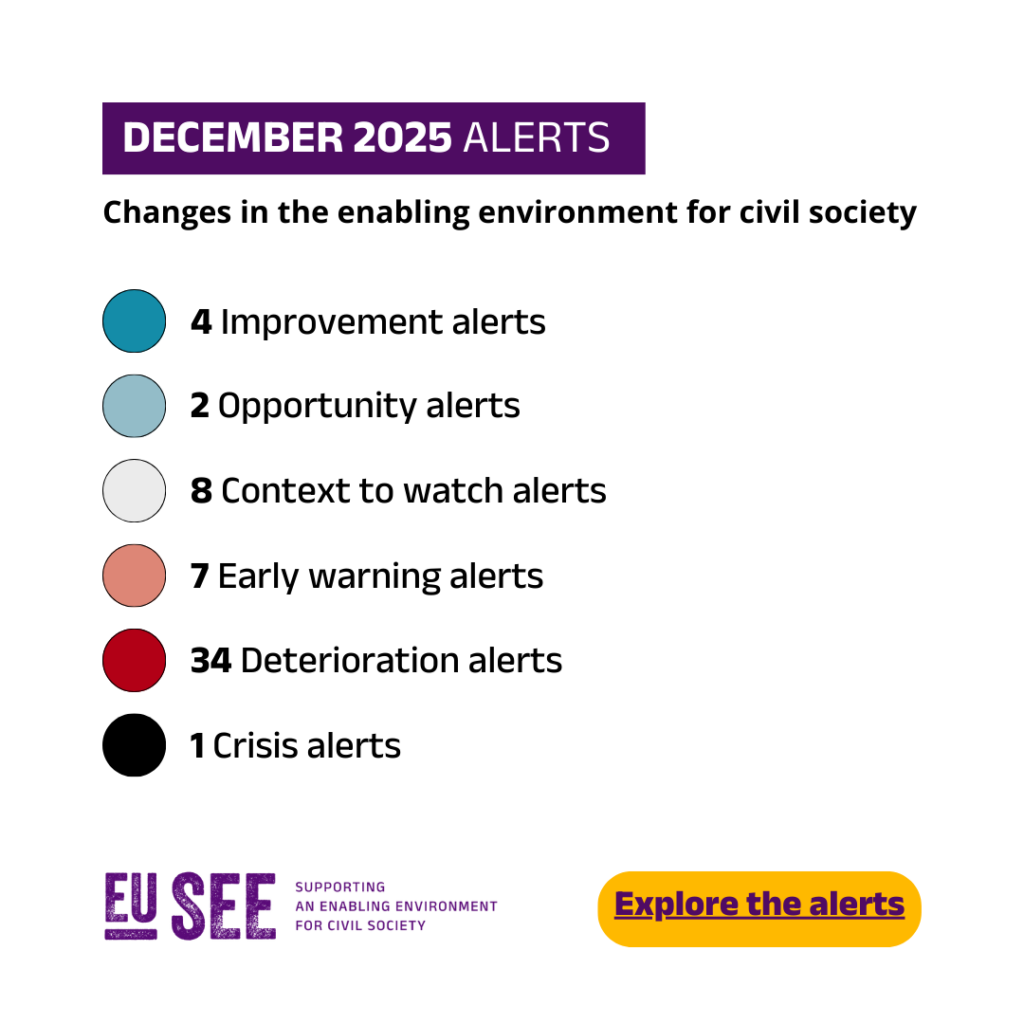
Emerging Trends
Free and Fair Elections under Threat
On 11 December 2025, Thailand’s Prime Minister Anutin Charnvirakul announced the dissolution of Parliament, which took effect the following day and brought the current legislative session to an abrupt end. As a result, the Amnesty Bill under consideration in the Senate lapsed in accordance with Section 147(1) of the 2017 Constitution. The Bill had sought to address politically motivated prosecutions linked to years of political unrest and protest-related charges.
During Honduras’ November 2025 general elections, significant signs of foreign interference and irregularities in the vote-counting process have heightened democratic fragility and increased risks for civic space. U.S. President Donald Trump publicly endorsed candidate Nasry “Tito” Asfura, calling him “the only true friend of freedom”. In another message, Trump warned Honduran authorities against “changing the results” and threatened “serious consequences” if Asfura did not win. The combination of direct public interference from a foreign government, public pressure on electoral authorities, and unexplained irregularities in the counting process undermines confidence in free and fair elections, weakens electoral-institution independence, and creates a more hostile environment for organisations defending democracy and human rights.
Since the 26th and 27th of November 2025, Guinea-Bissau has been facing major challenges in terms of the prohibition of democratic exercise and the lack of transparency in the elections, with the arrest of political figures. Guinea-Bissau was in the process of general elections, with the announcement of results scheduled for November 27. On the 26th, a coup d’État was carried out by the military, who called themselves the “High Command for the Restoration of Security and Public Order.” According to RDDH-GB’s information, on November 29, several arrests and beatings took place against young people who took to the streets to demonstrate and demand the announcement of the electoral results.
The Revolution will not be Televised: Governments Step Up Digital Restrictions on Freedom of Expression
The trial of prominent human rights lawyer Imaan Mazari and her husband Hadi Ali Chattha, both charged under the Prevention of Electronic Crimes Act (PECA) has become a landmark legal and human rights event in Pakistan, raising serious questions about freedom of expression, due process, and the use of cybercrime legislation against dissenting voices. Overall, the Imaan Mazari and Hadi Ali Chattha case has come to symbolise a broader and deeply concerning trend in Pakistan, the criminalisation of criticism through cyber laws and the growing risks faced by lawyers, journalists, and human rights defenders who speak against powerful institutions.
On 5-6 December 2025, Facebook accounts of several Filipino media organizations, fact-checkers, and commentators were simultaneously taken down. These pages, including the award-winning online news site ‘Rappler’ founded by Nobel Peace Prize laureate Maria Ressa, are known to dispel disinformation and promote critical discourse that hold powerful personalities and institutions to account. While the accounts were all restored, netizens lament how the current systems Meta has in place, its automated algorithm and use of AI in initially responding to trademark infringement claims, are vulnerable to insidious and unauthentic reporting to perpetrate cyber-censorship.
On 4 December 2025, the Bir Mourad Raïs court (Algiers) sentenced Algerian journalist Saâd Bouakba to a three-year suspended prison sentence and a fine of one million dinars for “insulting and defaming” the “symbols of the National Liberation Revolution” and for “spreading false information” via information and communication technologies. In Bangladesh, veteran journalist Anis Alamgir was arrested in 14 December 2025 and then charged under Bangladesh’s Anti-Terrorism Act.
The increased monitoring of the digital space by Governments, and aggressive enforcement of laws that infringe upon freedom of speech, remains a key evolving battleground for civil society and the enabling environment.
The Enabling Environment is Increasingly Contested Across Borders
On 21 November 2025, Gary Aboud, corporate secretary of the environmental NGO Fishermen and Friends of the Sea (FFOS), alerted that his US B1/B2 visa had been “prudentially revoked” by the United States on the basis of unspecified “new information” suggesting he may be inadmissible to the United States. Aboud believes this is linked to his public opposition to US military maritime strikes on suspected drug-smuggling vessels in the Caribbean, which have killed over 80 people, including two Trinidadian nationals.
On 2 December 2025 in Venezuela, during a debate in the National Assembly regarding the loss of Citgo’s assets—an oil company owned by PDVSA in the United States—the possibility was raised of revoking the nationality of several Venezuelans accused of having facilitated the loss of those assets.
These developments harken back to a November alert in Thailand, highlighting the potential transnational evolution of SLAPP cases. On 17 November 2025, Mr. Murray Hunter, an Australian independent journalist residing in Thailand, was indicted under Section 328 (defamation by publication) of the Thai Criminal Code (Black Case No. Aor. 2120/2568). This case stems from four articles that were published on his Substack between 13 and 29 April 2024, that, according to the public prosecutor, allegedly defamed the Malaysian Communications and Multimedia Commission (MCMC), a Malaysian government agency that filed a complaint. This case could lead to a change in precedent of other countries utilizing Thailand’s Criminal Code to prosecute dissenters in Thailand. In other words, this risks opening the door to more translational SLAPP cases in the future.
On 24 November 2025, the U.S. Department of Homeland Security (DHS) terminated Temporary Protected Status (TPS) for Myanmar, effective 26 January 2026, potentially forcing thousands of Myanmar nationals in the U.S. into deportation proceedings. DHS justified the termination by asserting that conditions in Myanmar have sufficiently “improved”—a claim starkly contradicted by the U.S. State Department’s own travel advisories and UN reports. Compounding this crisis, on 2 December 2025, the U.S. Citizenship and Immigration Services (USCIS) announced a pause on reviewing all pending applications for green cards, citizenship, and asylum from immigrants from 19 countries, including Myanmar. These combined actions create a multi-front immigration blockade, trapping approximately 4,000 TPS holders and countless other Myanmar nationals in legal limbo, stripping them of protections and pathways to permanency, and dramatically increasing their risk of forced return to an active conflict zone.
Visa refusals, revoked nationalities, endorsements and threats across countries are on the rise, with governments working together to repress civil society actors. These tactics are being used as an intimidating message toward civil society actors to instill fear, which may hinder the free work of civil society and obstruct the functioning of an enabling environment.
CSOs Fight Back in the Courts
On 16 December 2025, Paraguayan civil society organizations filed an Action of Unconstitutionality against Law No. 7363 before the Supreme Court. The so-called “Anti-NGO Law” or “Garrote Law” was enacted in November 2024 and eventually put into force on 23 October 2025 through Decree No. 4806. The Action of Unconstitutionality highlights the adverse environment for CSOs and the decision of the Supreme Court will determine whether this disabling legal framework will be maintained or whether the state will move towards more robust protection of fundamental freedoms.
November Country Focus Reports and Snapshots
- Costa Rica Country Focus Report
- Nigeria Country Focus Report
- Algeria Country Focus Report (French)
- El Salvador Country Focus Report
- Botswana Country Focus Report
- Kenya Country Focus Report
- Hong Kong Country Focus Report
- Pakistan EE Snapshot
- Indonesia EE Snapshot
- Bolivia EE Snapshot
- Bolivia EE Snapshot (Spanish)
See all EU SEE alerts and subscribe for updates here: https://eusee.hivos.org/alerts