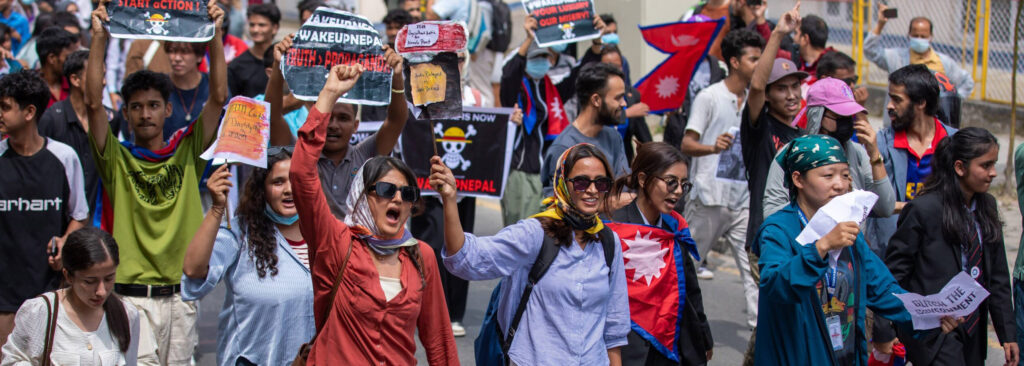
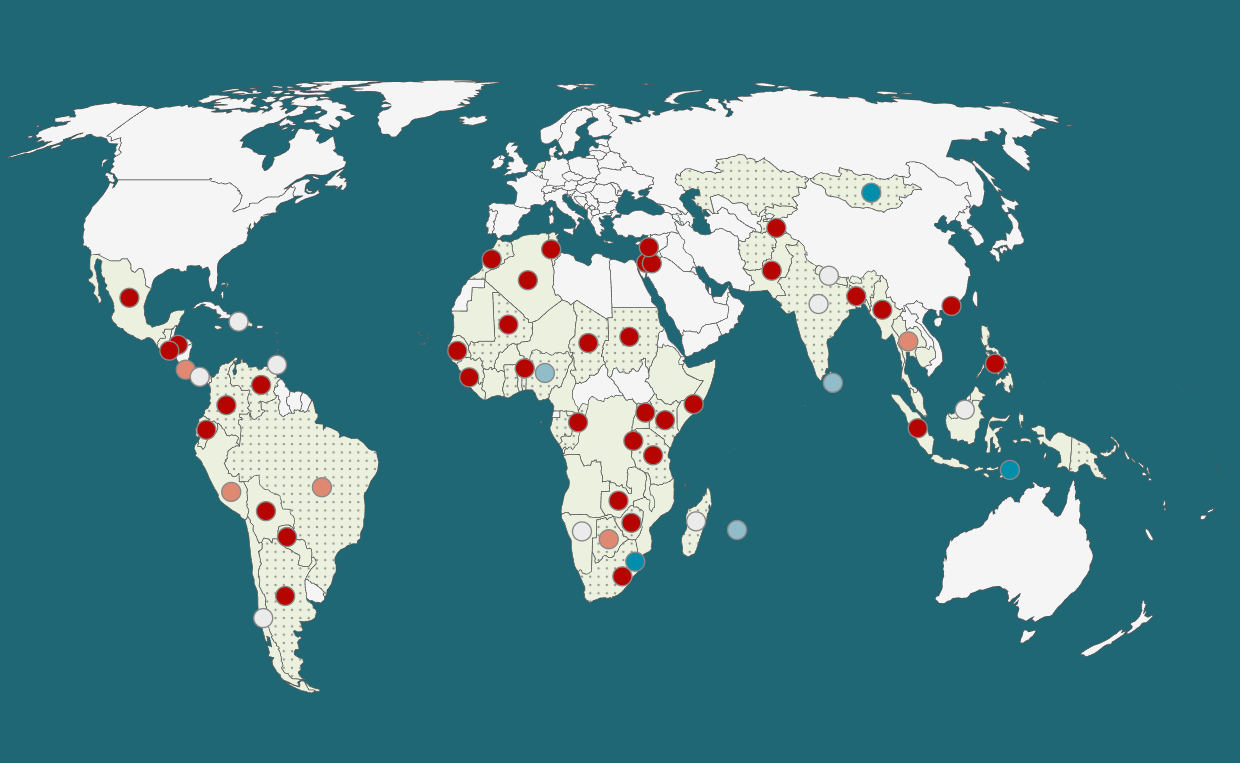
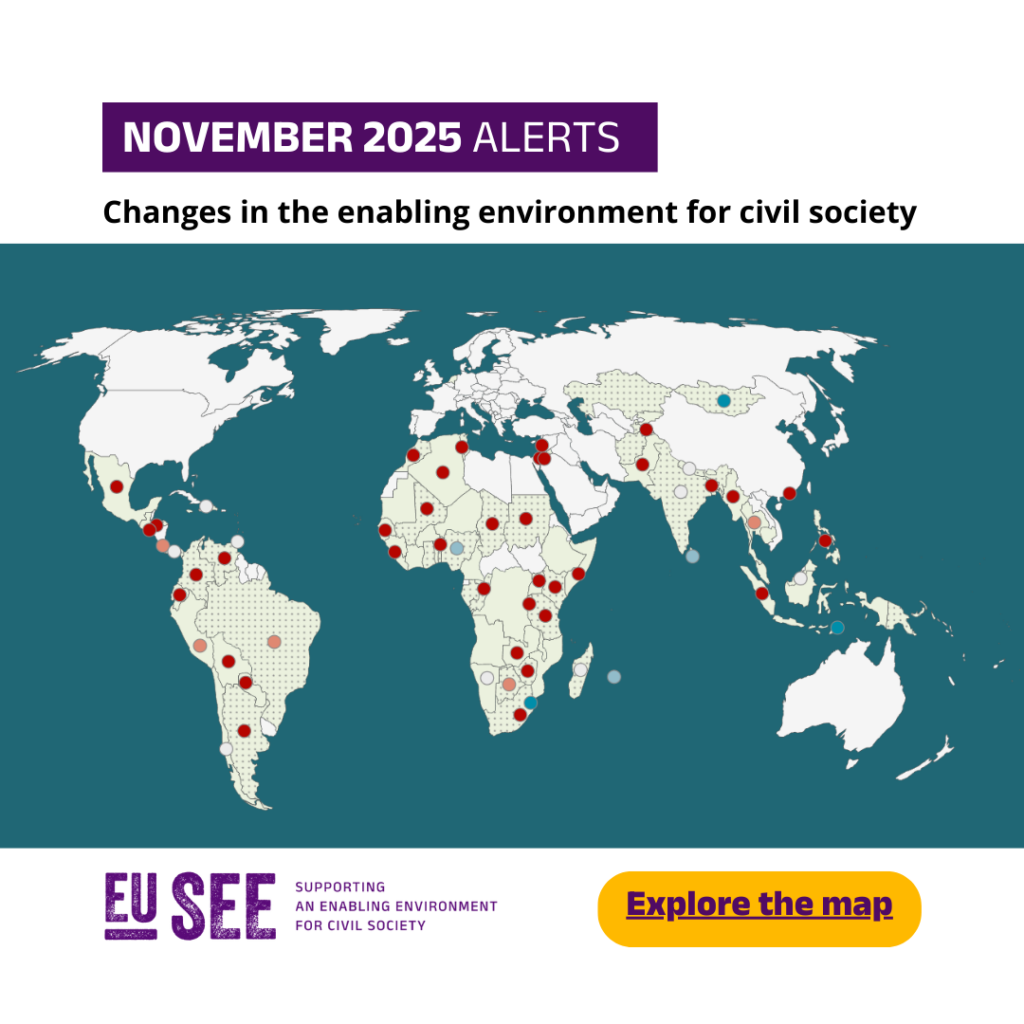
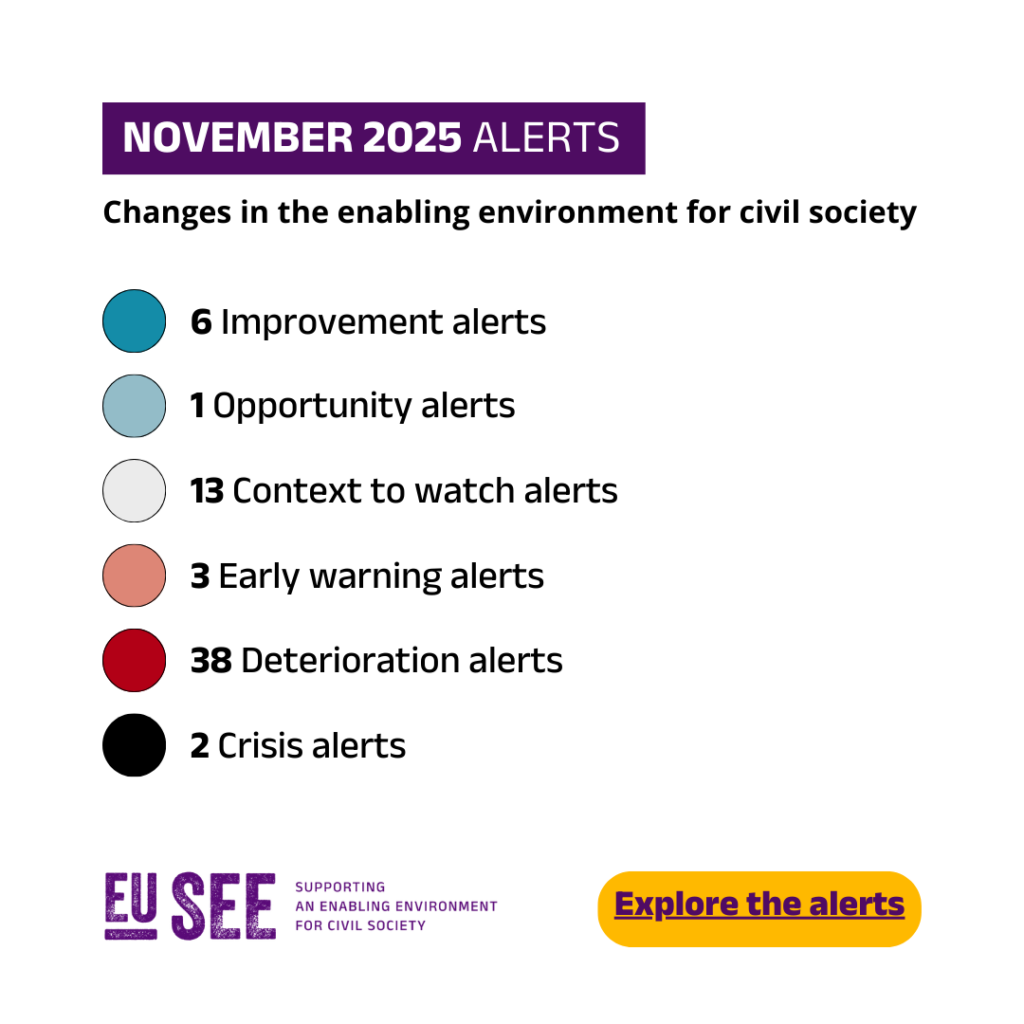
A significant 63 alerts were published across the EU SEE programme in November, including two crisis alerts. One related to ongoing challenges around the functioning of civil society organisations in Gaza and the other referring to a serious public order alert following clashes in Colombia.
The month of November was characterised by a high number of deterioration events across the board, as the enabling environment for civil society continues to be undermined globally as assessed across the EU SEE’s six enabling environment principles.
Emerging Trends
Electoral Violence in the Spotlight during Election Season
A draft Electoral Decree was launched at the start of the month in Haiti to get the ball rolling on a move towards elections in late 2026. While the text formally acknowledges civil society organizations (CSOs) as sources of proposals for polling station staff, it does not grant advisory or decision-making roles. Nor does it define accreditation, protection, or rights for election observers—limiting CSOs’ ability to monitor elections, a critical function in fragile transitions.
The situation in Tanzania following the October 29 election was marked by violence, abductions, and an internet shutdown. The shutdown drew criticism from human rights groups and opposition figures who argued that it violated citizens’ rights to access information and further deepened concerns over the credibility of an election already marred by arrests of opposition leaders and allegations of repression. Collectively, these events have deepened public unease over the state of political freedom, human rights, and accountability in Tanzania, signaling a high-risk environment for civic engagement, opposition activity, and human rights advocacy.
In the lead-up to Uganda’s January 2026 general elections, Ugandan security forces have intensified crackdowns on opposition figures and their associates. This crackdown highlights broader patterns of transnational political repression in East Africa, including abductions in Tanzania earlier in 2025, amid rising concerns over democratic backsliding ahead of elections in Uganda in January 2026, and Kenya in 2027, and the region’s recent polls in Tanzania in October 2025.
In Benin, On 14 November 2025, the Parliament adopted Law No. 2025-20, amending the Constitution (Law No. 90-32 of 11 December 1990, as revised by Law No. 2019-40 of 7 November 2019). The reform introduces significant constitutional changes and raises serious concerns regarding its democratic legitimacy. Notably, the reform follows the exclusion of all opposition parties from the upcoming elections.
Policing Expression, Online and Offline
The harsh policing of dissenting expression continues; in Jordan the former secretary-general of the dissolved Rescue and Partnership Party saw his charges upheld for a critical Facebook post made in 2023.
In Bangladesh, On 20 November 2025, Baul singer Abul Sarkar was arrested on allegations of hurting religious sentiment during a pala gaan performance on 4 November at the Khala Pagli fair in Jabra, Ghior. Transparency International Bangladesh publicly condemned the arrest and warned of the growing threat of extremism to artistic freedom and civic space.
In the same vein, the Indonesian Law Ministry has finalized the draft Cybersecurity and Cyber Resilience Bill (RUU KKS) as of 1 October 2025, and submitted it to the House of Representatives for prioritization in the 2026 legislative agenda. The Bill continues the militarization in Indonesia’s cybersecurity domain as part of a broader trend of expansion of military reach in civilian areas of governance. Since late 2024, the government has progressively integrated TNI into cyber operations, beginning with the creation of a dedicated military cyber force in November 2024 following a high-profile data breach at the TNI’s Strategic Intelligence Agency.
Law as a Tool of Oppression
Algerian civil society is drawing attention to the detention of peaceful activists in the country; the numbers of which have grown at an alarming rate. Despite these calls, the Government continues to deploy anti-terrorism laws to detain activists, resulting in a five-year sentence for poet activist Mohamed Tadjadit. This follows the late October sentencing of critical human rights defender Ali Mammeri to 15 years in prison on charges of “glorifying terrorism” and “disseminating classified information via electronic means of communication.”
In Uganda, GIZ has temporarily paused its Strengthening Governance and Civil Society Programme (GCSP) after the Office of the Auditor General (OAG) and the National Planning Authority (NPA) requested a halt pending clearance from the Attorney General. The pause reflects a broader pattern of Ugandan government crackdowns on foreign-funded civil society and governance programs. It severely disrupts civil society organizations (CSOs) dependent on GCSP support.
The decision by the Ministry of Administration, Territory and Decentralization in Chad, published on 17 September 2025, to revoke the nationality of Makaila Nguebla, an activist and former human rights adviser to the presidency, as well as journalist Charfadine Galmaye, raises serious concerns about the repression of dissenting voices and respect for human rights in the country. The deployment of the deprivation of nationality of Makaila Nguebla and Charfadine Galmaye is a major event that reflects the growing tensions between the Chadian government and civil society.
November Country Focus Reports and Snapshots
- Afghanistan EE Baseline Snapshot
- Thailand EE Snapshot
- Mauritius EE Baseline Snapshot
- Bangladesh EE Baseline Snapshot
- Mexico EE Snapshot (Click here for Spanish)
- Paraguay Country Focus Report (Click here for Spanish)
- The Gambia Country Focus Report
- Jamaica Country Focus Report
- Cambodia Country Focus Report
- Timor-Leste Country Focus Report
- Algeria Country Focus Report
- Hong Kong Country Focus Report
See all EU SEE alerts and subscribe for updates here: https://eusee.hivos.org/alerts